
![[HERO] A wide professional hero banner for the CLARITY Act 2025](https://cdn.marblism.com/ZxiXZxLazyo.webp) The digital asset industry has long operated in a regulatory gray zone.
The digital asset industry has long operated in a regulatory gray zone.
For years, compliance teams and law enforcement investigators have struggled with overlapping jurisdictions, unclear asset classifications, and inconsistent enforcement standards.
The Digital Asset Market Clarity Act of 2025 (H.R. 3633): commonly known as the CLARITY Act: aims to change that. Passed by the House on July 17, 2025, this comprehensive 200-plus page framework establishes clear rules for how digital assets are classified, regulated, and monitored.
For compliance professionals at regulated financial institutions and investigators working crypto-related cases, understanding this legislation is no longer optional. Here are five essential facts you need to know.
Fact 1: Clear Jurisdictional Boundaries Between the SEC and CFTC
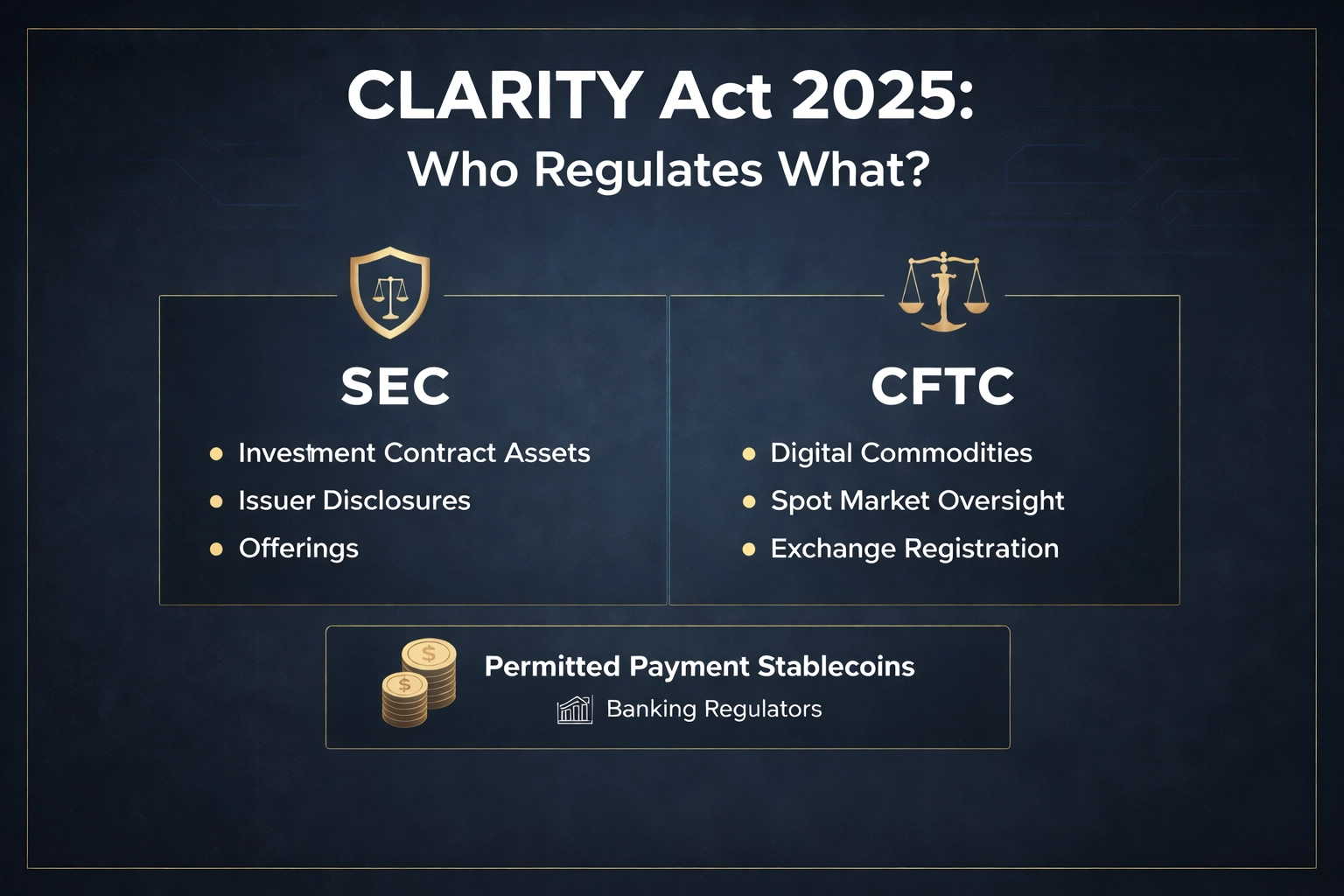
One of the most significant challenges in crypto regulation has been determining which federal agency has authority over specific assets and activities. The CLARITY Act resolves this by drawing clear lines between the Securities and Exchange Commission (SEC) and the Commodity Futures Trading Commission (CFTC).
Under the new framework:
-
The CFTC receives exclusive jurisdiction over digital commodity spot markets. This includes anti-fraud and anti-manipulation enforcement for assets like Bitcoin and Ethereum. The CFTC also gains authority to register digital commodity exchanges, brokers, and dealers.
-
The SEC maintains exclusive jurisdiction over investment contract asset issuers and issuances. The SEC also retains anti-fraud authority over digital commodities transacted on SEC-registered platforms.
For compliance teams, this means clearer reporting lines and more predictable enforcement actions. For investigators, it provides a defined framework for understanding which agency to coordinate with based on the asset type involved in a case.
The Act also mandates joint SEC-CFTC rulemaking to further define asset classes and establish delisting criteria. This collaborative approach should reduce the regulatory ambiguity that has historically complicated cross-agency investigations.
Fact 2: Three-Category Asset Classification System
The CLARITY Act introduces a structured classification system that divides digital assets into three distinct categories:
Digital Commodities
These are assets whose value derives primarily from blockchain functionality rather than from an expectation of profit based on the efforts of others. Bitcoin and Ethereum fall into this category. Digital commodities are regulated by the CFTC.
Investment Contract Assets
When digital commodities are sold for capital-raising purposes, they may be treated as securities under this classification. These assets fall under SEC jurisdiction, and issuers must comply with securities laws during their offering phase.
Permitted Payment Stablecoins
Digital assets designed as a means of payment and denominated in national currency receive their own classification. Stablecoin issuers are subject to banking regulation rather than securities or commodities oversight.
This three-tier system provides compliance teams with a clear framework for determining which regulatory requirements apply to specific assets. It also helps investigators understand the legal context when tracing funds across different asset types.
Fact 3: The Certification of Decentralization Mechanism
Perhaps the most innovative aspect of the CLARITY Act is the “Certification of Decentralization” process. This mechanism allows digital asset issuers to formally assert that their blockchain network meets specific decentralization standards.
To qualify, an issuer must demonstrate decentralization across three key areas:
- Governance – No single entity or coordinated group controls network decisions
- Token Distribution – Tokens are broadly distributed rather than concentrated among insiders
- Development Control – No central party controls the ongoing development of the protocol
When an issuer files this certification with the SEC, it creates a rebuttable presumption that the asset qualifies as a digital commodity rather than a security. This shifts the burden of proof to regulators who might argue otherwise.
For compliance teams, this certification provides a clear indicator of an asset’s regulatory status. For investigators, it establishes an evidentiary framework for understanding how specific assets should be treated in legal proceedings.
Fact 4: Mandatory Registration and Consumer Protection Standards
The CLARITY Act establishes robust requirements for intermediaries handling digital commodities. Exchanges, brokers, and dealers must register with the CFTC and comply with comprehensive operational standards.
Key requirements include:
- Capital Requirements – Firms must maintain adequate capital reserves
- Risk Management – Documented procedures for identifying and mitigating operational risks
- Recordkeeping – Detailed transaction records must be maintained and made available to regulators
- Reporting – Regular reporting to the CFTC on trading activity and compliance status
- Business Conduct Standards – Rules governing fair dealing and market integrity
- Customer Protection – Fund segregation requirements to protect customer assets
The customer protection mandates are particularly significant. Fund segregation requirements mean that customer assets must be held separately from company operating funds. This reduces the risk of customer losses in the event of firm insolvency: a concern that has been highlighted by several high-profile exchange failures in recent years.
For compliance teams at financial institutions that interact with crypto exchanges, these standards provide a baseline for due diligence. You can now evaluate exchange partners based on their CFTC registration status and compliance with these defined requirements.
Fact 5: Implications for Case Coordination and Intelligence Sharing
While the CLARITY Act primarily addresses regulatory classification and consumer protection, it has significant implications for how law enforcement and compliance teams coordinate on crypto-related investigations.
With clear jurisdictional boundaries, agencies can more efficiently route cases to the appropriate regulator. The mandatory recordkeeping requirements create standardized data that can be subpoenaed during investigations. And the registration framework provides investigators with a defined universe of regulated entities that must respond to legal process.
For organizations that handle multiple crypto-related cases, this clarity reduces friction in the investigation process. When you know which agency has jurisdiction over a specific asset type, you can structure your information requests and coordinate your efforts more effectively.
At Deconflict, we help compliance teams and law enforcement agencies navigate exactly these coordination challenges. Our platform provides case coordination tools and risk signal intelligence that account for the evolving regulatory landscape. As frameworks like the CLARITY Act reshape how digital assets are classified and monitored, having the right intelligence infrastructure becomes even more critical.
What Comes Next
The CLARITY Act represents a major step toward regulatory clarity for digital assets. However, the legislation still requires Senate passage and presidential signature before becoming law. Additionally, the joint SEC-CFTC rulemaking process will take time to complete.
Compliance teams should begin reviewing their current digital asset policies in light of the proposed framework. Consider how the three-category classification system would affect your current risk assessments and due diligence procedures.
Investigators should familiarize themselves with the jurisdictional boundaries established by the Act. Understanding which agency has authority over specific asset types will streamline your coordination efforts once the framework takes effect.
The regulatory landscape for digital assets is becoming clearer. Organizations that prepare now will be better positioned to adapt when these rules become final.
Book a 30-minute walkthrough to see how Deconflict can help your team navigate the evolving regulatory environment.