Darknet Moniker and Footprint Deconfliction
A trusted layer for federal, state, local, and tribal agencies working darknet, online-marketplace, and illicit-distribution investigations. Surface overlap on the identifiers your subjects use to operate, without exposing the case, the source, or the technique.
Built for the investigations that follow a handle across every platform.
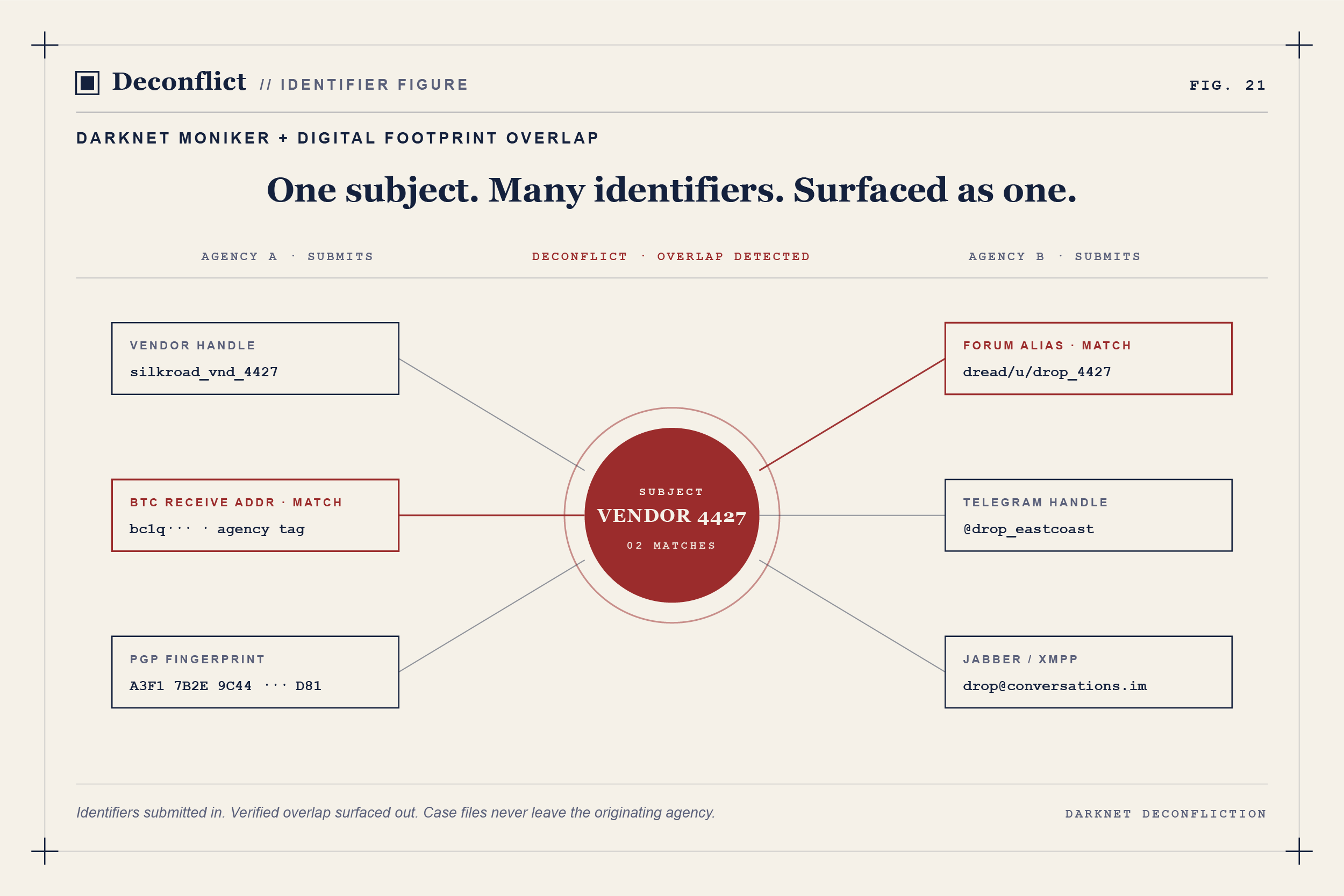
Deconflict now enables law enforcement to deconflict darknet monikers and the full digital footprint attached to them. From vendor handles and forum aliases to PGP fingerprints, encrypted-messaging IDs, and the cryptocurrency addresses tied to a storefront, agencies can detect overlap on the same target in real time, and coordinate before two investigations collide.
Protecting
American Families.
What darknet investigators face today.
Same Vendor, Different Agencies
The same handles, the same PGP keys, and the same delivery patterns surface in cases across federal, state, local, and tribal agencies every day. Without a coordination layer, agencies pursue parallel investigations on a single subject and undercut what should be a consolidated case.
Footprints That Cross Platforms
A moniker on one marketplace becomes a jabber ID on another, a Telegram handle on a third, and a receive address on the fourth. Following the digital footprint across platforms is hard. Doing it without colliding with another agency's wire, CI, or undercover operation is harder.
The Disclosure Cost
Traditional coordination on darknet subjects means picking up a phone, naming a vendor, and trusting the person on the other end has clearance, jurisdiction, and discretion. Most investigators don't make the call. The deconfliction never happens, and the conflict surfaces in court.
Moniker and footprint deconfliction.
01
Submit Only the Identifier
02
Verified Agency Access
03
Real-Time Overlap
From a single handle
to a full digital footprint.
One subject, many identifiers,
surfaced as one.