
TL;DR
- Treasury’s GENIUS Act proposed rule defines when a payment stablecoin is issued in the U.S. and when it is offered or sold to a person in the U.S.
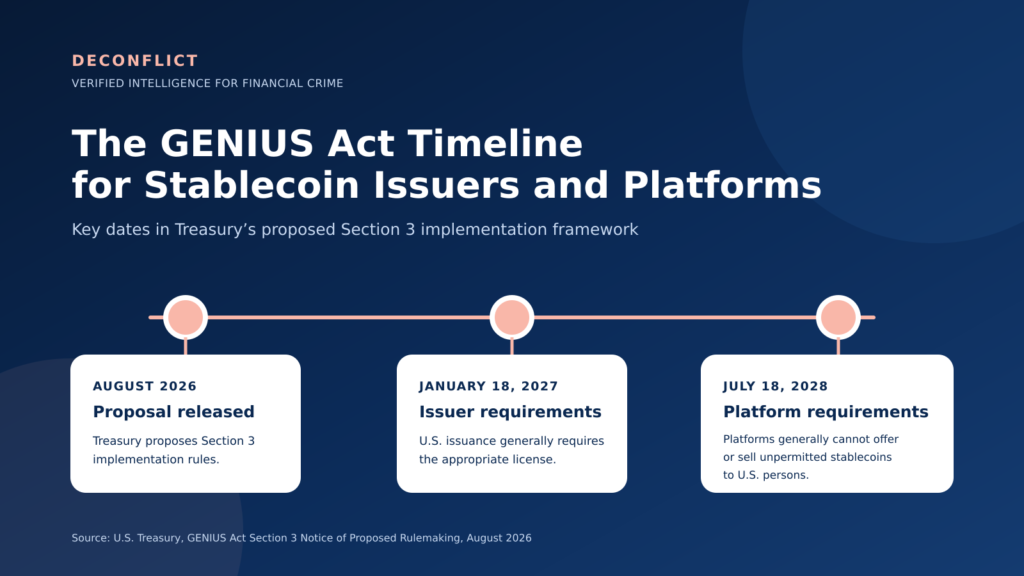
- From January 18, 2027, an issuer generally cannot issue a payment stablecoin in the U.S. without the appropriate federal or state license.
- From July 18, 2028, digital asset service providers generally cannot offer or sell payment stablecoins to U.S. persons unless they are issued by a permitted issuer.
- Foreign issuers are not automatically excluded, but they must meet specific conditions to operate in the U.S. market.
- The Treasury will accept public comments for 60 days after the proposal is published in the Federal Register.
The U.S. Treasury has started answering a question that will shape the next phase of the stablecoin market: when does a payment stablecoin fall within the U.S. regulatory framework?
Treasury’s new GENIUS Act proposed rule does not create a new stablecoin law. The GENIUS Act already does that. This proposal explains how Treasury intends to apply Section 3 of the Act, which governs who can issue payment stablecoins in the United States and when digital asset service providers can offer or sell them to people in the country.
The details matter because stablecoins are increasingly used for payments and settlement. A token may be accessible online from almost anywhere, but that does not answer whether an issuer or platform is actively bringing it into the U.S. market.
The Treasury is now proposing definitions for that line.
What is the Treasury proposing under the GENIUS Act?
On August 17, 2026, Treasury issued a Notice of Proposed Rulemaking, or NPRM, for the issuance, offering and sale of payment stablecoins in the U.S. The proposal focuses on Section 3 of the GENIUS Act, not the entire law. It is still a proposal and will not become binding unless the Treasury finalizes it after the comment process.
For issuers, this will determine whether a license is required. For exchanges, custodians and other digital asset service providers, the answers may determine which stablecoins can be made available to U.S. users and what checks are needed before doing so.
Read Treasury’s announcement and the full proposed rule.
When would a stablecoin be considered issued in the U.S.?
Treasury proposes that a payment stablecoin is issued when it is first transferred to another person. In other words, the key moment is not when tokens are technically minted. It is when another person first receives the right to use, transfer or redeem them.
Under the proposal, an issuance would generally be considered to occur in the U.S. if, at the time of that first transfer, either the issuer or the recipient is located in the United States.
This is an important distinction for cross-border activity.
A foreign issuer may create tokens outside the U.S., but a first transfer to a recipient located in the U.S. could still bring that issuance within the rule. On the other hand, a U.S. citizen who is physically outside the country would not necessarily be treated as a person located in the U.S. at that moment. Treasury’s proposed test looks at location, not citizenship.
Beginning on January 18, 2027, the expected effective date of the GENIUS Act, a person generally may not issue a payment stablecoin in the U.S. unless it has the appropriate federal or state license.
The GENIUS Act proposed rule also explains that returning a token to the issuer can reset the prior issuance. If the issuer later transfers that token to another person, that transfer may be treated as a new issuance.
For issuers, this turns a high-level licensing requirement into an operational question: where is the first transfer taking place, and what evidence supports that conclusion?
What could count as offering or selling a stablecoin in the U.S.?
The proposal also gives examples of conduct that may be treated as offering or selling a payment stablecoin to people in the U.S.
Examples include:
- Directly soliciting U.S. customers
- Advertising a stablecoin as available for purchase in the U.S.
- Responding affirmatively to an unsolicited request from a U.S. customer
- Entering into a sale contract with a person located in the U.S.
- Advising someone how to bypass location-detection or access restrictions designed to block U.S. purchases
This is where the proposal becomes especially relevant for exchanges and other platforms.
A stablecoin appearing on a global website is not necessarily the same as a platform offering it to U.S. users. Yet targeted marketing, product design and customer interactions can change that analysis.
Beginning on July 18, 2028, digital asset service providers generally may not offer or sell a payment stablecoin to a person in the U.S. unless it is issued by a permitted payment stablecoin issuer.
The proposal does not treat every transaction alike. The Act includes exemptions for direct transfers between two individuals acting on their own behalf, transfers between a person’s own U.S. and foreign accounts at the same parent company and transactions using software or hardware wallets for self-custody.
Treasury is also seeking comment on unresolved issues, including whether a free stablecoin airdrop should count as an offer even when the recipient provides no payment.
What does the rule mean for foreign stablecoin issuers?
The GENIUS Act proposed rule does not close the U.S. market to foreign issuers. It sets conditions for access.
A foreign payment stablecoin issuer may be able to issue payment stablecoins in the U.S. if it is regulated and supervised in a jurisdiction the Treasury considers comparable to the U.S. framework and registers with the Office of the Comptroller of the Currency.
Foreign-issued stablecoins also face an earlier platform-level requirement. From the expected January 18, 2027 effective date, a digital asset service provider generally cannot offer, sell or otherwise make available a foreign-issued payment stablecoin in the U.S. unless the issuer has the technological capability to comply with lawful U.S. orders and agrees to comply with those orders and any relevant reciprocal arrangement.
Treasury specifically discusses technical capabilities that could allow an issuer to respond to lawful orders relating to tokens, such as the ability to freeze, seize or burn assets. The proposal does not establish a mandatory technical audit for those functions, but platforms cannot ignore the question.
A platform may rely on a foreign issuer’s statement about compliance only after conducting reasonable due diligence. If it knows, or has sufficient reason to believe, that the statement is false, it cannot rely on it.
That creates a practical challenge. Platforms will need a process for evaluating issuer representations, technical capabilities, jurisdictional status and the evidence that supports their decision.
Why does this matter for stablecoin businesses?
The most useful part of the GENIUS Act proposed rule is not that it offers a simple approved or prohibited list of stablecoins. It begins defining the conduct around them.
For an issuer, the ambiguity may be whether a first transfer is considered U.S. issuance. For a platform, it may be whether marketing, customer support or a product flow is effectively making a stablecoin available in the U.S. For a foreign issuer, it may be whether its legal and technical arrangements meet the Act’s conditions.
Businesses will need to connect legal requirements to real product flows: onboarding, geolocation, marketing, listing, custody, redemption and customer support. They will also need records that explain how they reached their decisions.
That is where ambiguity becomes operational. The issue is not merely whether a stablecoin exists on a platform. It is whether the platform’s actions make it available in a way that falls within the U.S. framework.
What happens next?
The Treasury will accept public comments for 60 days after the NPRM is published in the Federal Register. The comments will be publicly available through Regulations.gov.
This is the stage when issuers, exchanges, consumer groups, technologists, compliance teams and other stakeholders can test Treasury’s proposed definitions against real-world scenarios.
The questions worth raising include:
- Can platforms apply the location test consistently across global users?
- What due diligence should be sufficient when evaluating foreign issuers?
- How should airdrops, bridges and wrapped stablecoins be treated?
- Are the proposed exemptions broad enough for ordinary self-custody and person-to-person activity?
- Where might legitimate business activity be captured unintentionally?
The Treasury will consider the comments before issuing a final rule.
For anyone issuing, listing, holding or advising on payment stablecoins, the comment period is a chance to identify where the proposed framework works, where it creates uncertainty and what it will take to apply the final rules in practice.
FAQs
Is the GENIUS Act proposed rule final?
No. It is a Notice of Proposed Rulemaking. The Treasury will receive public comments and may revise the proposal before issuing a final rule.
When does the GENIUS Act take effect?
The expected effective date is January 18, 2027. The prohibition on digital asset service providers offering or selling payment stablecoins to U.S. persons unless they are issued by a permitted issuer begins July 18, 2028.
Can foreign stablecoin issuers operate in the U.S.?
Potentially. Under the GENIUS Act proposed rule, foreign issuers may operate if they meet the Act’s conditions, including comparable foreign regulation and OCC registration.
Does the proposal apply to self-custody wallets?
The Act provides exemptions for certain self-custody wallet transactions, direct person-to-person transfers and transfers between a person’s own accounts at the same parent company.
What should exchanges and platforms do now?
They should review their stablecoin listing, marketing, user-location and issuer due-diligence processes, then consider whether Treasury’s proposed definitions work for their actual product flows.