
TL;DR
The FATF July 2026 report outlines how a public-private partnership framework turns fragmented compliance data into active, real-time threat intelligence. It provides a blueprint to bypass regulatory bottlenecks and scale cross-border cooperation to freeze illicit assets before they move.
For investigators, detectives, and compliance officers fighting financial crime, the bottleneck has never been a lack of effort, it has been a lack of connection. While transnational fraud syndicates and digital asset launderers move stolen funds across the globe in seconds, the professionals chasing them remain isolated within strict legal, institutional, and geographic perimeters. This fragmentation creates systemic blind spots that criminal networks exploit with highly sophisticated, split-second precision.
To dismantle these operational barriers, the Financial Action Task Force (FATF) July 2026 report, Information Sharing to Combat Illicit Finance, delivers a comprehensive, 60-page evaluation of global collaborative frameworks. Serving as an authoritative FATF guide on Public-Private Partnerships (PPPs) for AML, the report outlines how leading jurisdictions are shifting from isolated compliance check-boxes to active, integrated threat networks to change the math of asset recovery.
Below, we unpack the four critical pillars of the FATF report, mapping global adoption, analyzing governance structures, identifying regulatory roadblocks, and outlining the evolution of fast-paced cross-border tracking. Finally, we explore how these findings directly shape the future of real-time investigative deconfliction.
1. Mapping Global Adoption: What the Figures Reveal
The report maps at least 84 active public-private partnership (PPP) initiatives across 51 jurisdictions. Regionally, Europe leads adoption with 23 jurisdictions, followed by the Asia-Pacific region with nine, the Middle East and North Africa (MENA) with seven, and the Americas and Africa with six each.
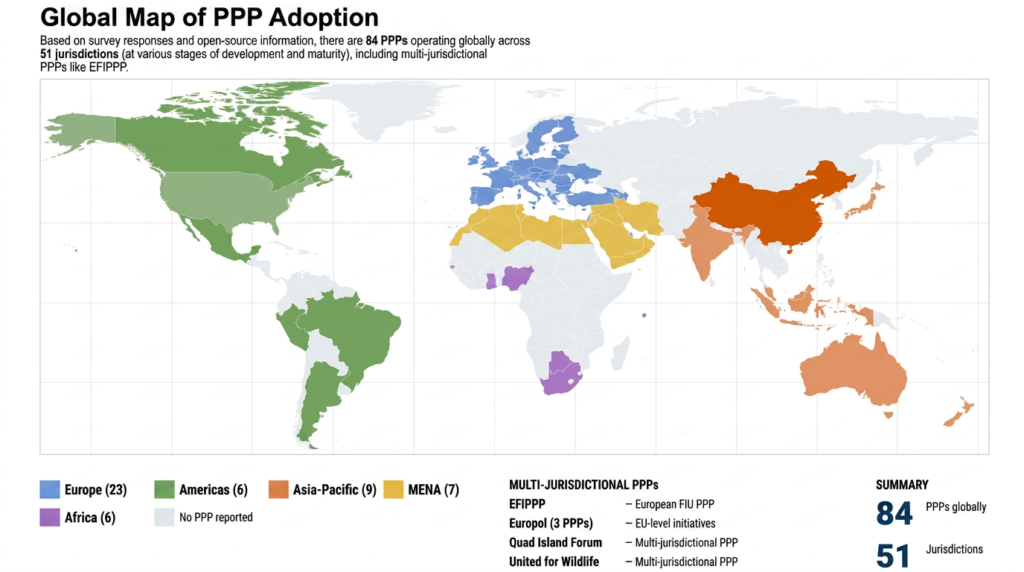
For an active investigator, however, raw adoption metrics do not tell the whole story. These 84 partnerships span a wide operational spectrum:
- At one end are emerging, advisory discussion forums focused on long-term policy.
- At the other are advanced operational partnerships featuring daily communications, shared analytical units, and near-real-time data exchange.
The primary metric of success is not how many forums exist, but whether a public-private partnership can move actionable, verified intelligence to an investigator with the authority to freeze a compromised account before the funds are gone.
2. Partnership Governance: Who Leads the Network?
Building a functioning public-private partnership requires a clear operational anchor. In analyzing 58 surveyed partnerships, the FATF identifies three main leadership structures:
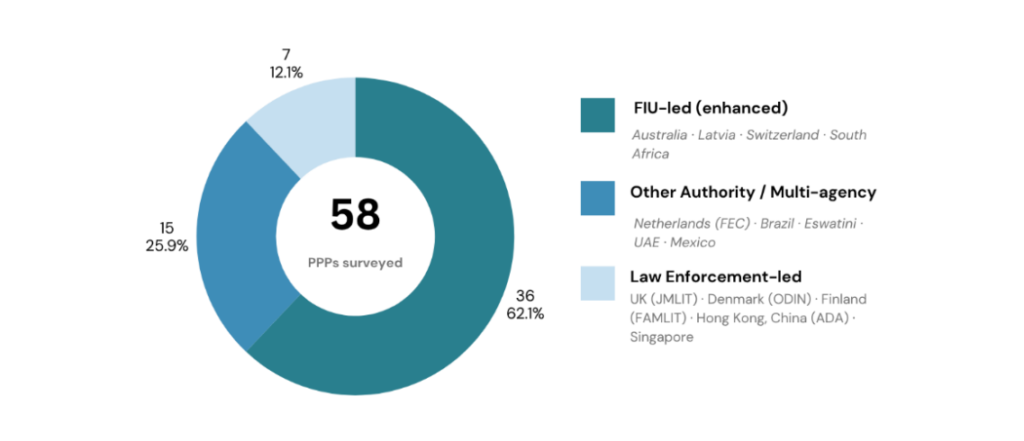
- FIU-Led (62.1%): 36 of the surveyed partnerships are run by Financial Intelligence Units (FIUs). Sitting at the intersection of private banking disclosures and public prosecutions, FIUs serve as a natural operational bridge.
- Multi-Agency / Other Authority (25.9%): 15 partnerships utilize co-chaired structures, specialized financial regulators, or dedicated fraud task forces.
- Law Enforcement-Led (12.1%): 7 partnerships are driven directly by police or federal investigative agencies.
3. Legal Barriers and the Reality of Technical Demands
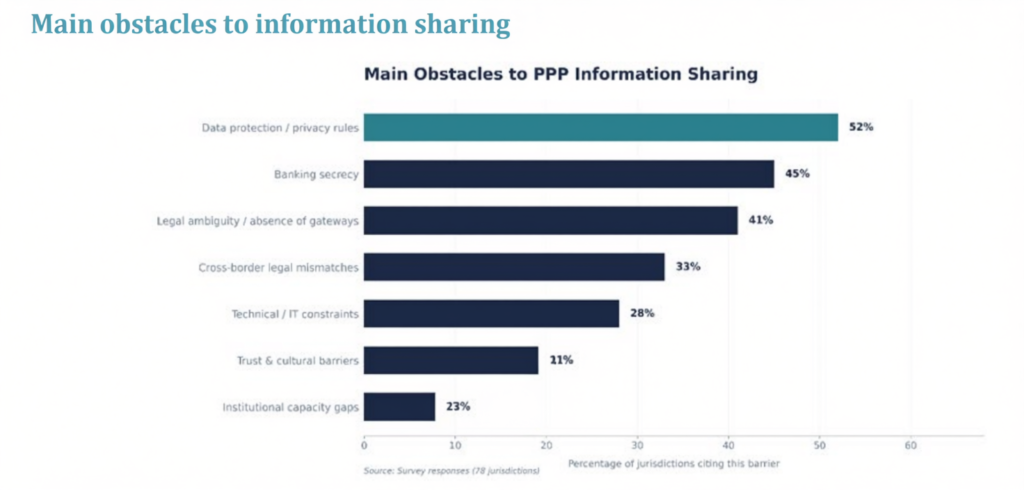
While technology is critical to modern investigations, the FATF survey data highlights that the primary bottlenecks preventing rapid information sharing are legal and regulatory:
Legal uncertainty is the single largest drag on investigative speed. When facing unclear rules, institutions naturally default to the most conservative interpretation to avoid liability, resulting in weeks of internal legal reviews while target accounts are cleared out by criminals.
To break this gridlock, the report highlights the critical role of explicit legislative gateways and safe-harbor protections, such as Singapore’s COSMIC statutory safe harbor or FinCEN’s Section 314(b) program. However, these legal permissions are only half the battle. To be usable, investigators and compliance teams require secure, privacy-preserving technical platforms that can quickly match and deconflict intelligence signals without exposing sensitive, non-public case files or protected personal data.
4. From Advisory Forums to Asset Recovery
The FATF highlights that public-private partnership models are evolutionary, starting as trust-building roundtables and maturing into highly integrated, cross-border operational networks. When structured properly, the real-world results of these networks are clear:
- Singapore’s Anti-Scam Centre: Recovered over $140 million in stolen funds through rapid coordination with financial institutions.
- Project FRONTIER+: This cross-border joint operation linked 13 jurisdictions, resulting in 2,100 arrests and freezing more than 36,000 mule accounts used to distribute illicit proceeds.
- The UK’s Legislative Evolution: Following the introduction of a dedicated sharing mechanism under the Economic Crime and Corporate Transparency Act (ECCTA), 65% of investigations triggered by shared intelligence in a six-bank sample resulted in direct, positive risk-mitigation.
In one notable UK case, Bank A warned Bank B of suspicious, high-velocity cash deposits and transfers. Armed with this warning, Bank B cross-referenced internal data to expose an underground banking network that had funneled over £10 million. The resulting coordination allowed investigators to secure £674,000 via Account Freezing Orders and file over 80 additional Suspicious Activity Reports (SARs).
5. Overcoming De-Risking and Protecting Fundamental Rights
As sharing networks scale, the FATF warns against the risk of unintended consequences, such as arbitrary account closures or systemic de-riskings. Simply offboarding a suspect account does not stop the illicit network, it merely displaces the risk to another institution and can inadvertently shut innocent, legitimate users out of the financial system.
Furthermore, partnerships must respect fundamental human rights, including privacy and the presumption of innocence. The modern, privacy-respecting networks are designed to prevent these issues by focusing on deconfliction. Rather than sharing entire case files, investigators and compliance teams can query basic, anonymized indicators, like a digital footprint or a crypto wallet address, to verify if an active investigation overlap exists without exposing PII.
The Deconflict Solution: Translating the FATF Blueprint Into Action
The core message of the FATF guide on public-private partnerships is that we must build communication channels before a live case lands on an investigator’s desk. That is exactly why Deconflict was founded by former U.S. Secret Service Special Agents.
We built Deconflict to close the exact operational gap identified in the FATF report. As a free, tool-agnostic intelligence hub trusted by over 1300 law enforcement agencies across 50 states and 35+ countries, Deconflict allows investigators to easily identify overlapping cases involving criminal networks and digital assets.
By providing financial institutions and agencies with a real-time interface to query active law enforcement intelligence signals, Deconflict enables risk assessment and investigations that disrupts fraud, fully aligning with the FATF’s vision of a secure, outcomes-driven public-private partnership.
To see a practical discussion on how this intersection of law enforcement and banking works in action, watch Inside Deconflict: Bridging Law Enforcement and Banking.
Align your institution with the new global standard. Request a demo or visit Deconflict.com to know more.