TL;DR
- Blockchain analytics traces transactions, identifies services, and assesses on-chain exposure.
- Deconfliction helps authorized organizations understand whether an identifier has relevant investigative context elsewhere.
- A transaction path can guide an investigation, but it cannot independently establish intent, ownership, or whether another agency is already examining the same activity.
- The strongest workflow combines on-chain analysis, internal records, verified context, appropriate coordination, and human judgment.
- Deconflict complements analytics and monitoring tools by adding context at the point where a team needs to decide what to do next.
Blockchain analytics has transformed what investigators and financial-crime teams can see. A transaction hash can reveal how value moved, which services were involved, where assets converged, and whether an address has known exposure to illicit activity.
That visibility is essential. It is not, however, the full investigation.
Deconfliction answers a different question: is another authorized organization already examining this identifier, and would that fact change the next step?
In fraud, sanctions, and cyber-enabled crime cases, understanding the route of funds is different from understanding the investigative context around them. A wallet may be linked to suspicious activity, a transaction may interact with a high-risk service, or an address may share patterns with other concerning flows. Those findings can justify a deeper review. They do not show whether the activity is part of an active case, whether another agency holds relevant victim information, or whether preservation action is already underway.
Blockchain analytics and deconfliction are not competing methods. They solve different parts of the same problem.
What does blockchain analytics do?
Blockchain analytics turns public ledger data into information teams can investigate. It maps transaction flows, identifies patterns, connects addresses to known services, and surfaces exposure to reported illicit activity.
For an exchange, bank, or payment company, that may mean identifying whether a customer wallet received funds from a sanctioned address, whether value passed through a mixer, or whether a transaction appears connected to a fraud typology.
Without analytics, teams would be left manually interpreting transaction histories across multiple chains, protocols, and services. The tools make on-chain activity legible at a scale that would otherwise be impossible.
Still, an analytical finding is not a complete investigative conclusion.
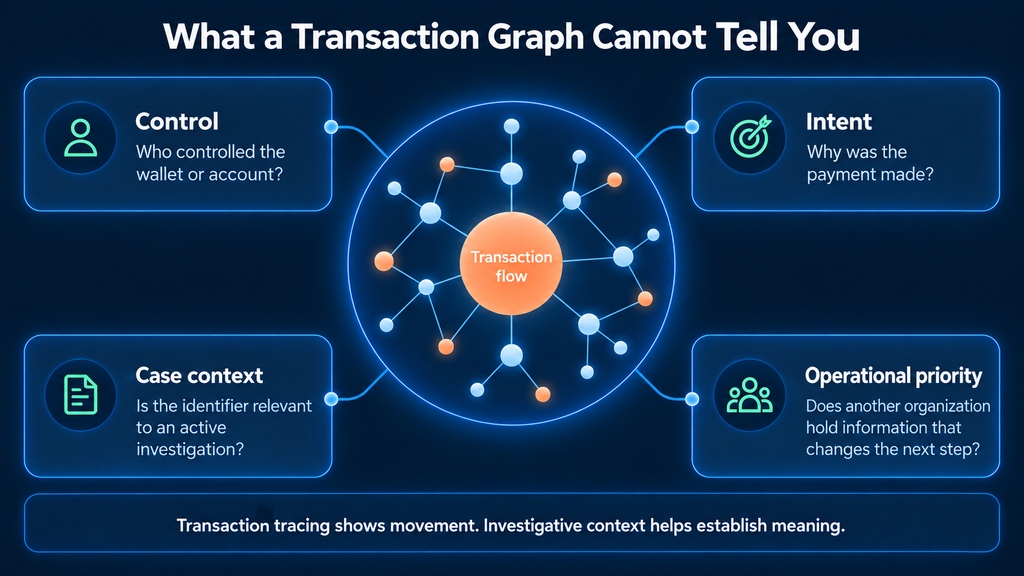
A cluster may be based on a technical heuristic. A label may reflect open-source research, prior reporting, or an attribution made by a data provider. A risk indicator can show that an address deserves attention, yet it cannot independently establish who controlled the wallet, why a payment occurred, or whether law enforcement is already investigating related activity.
That is not a limitation of blockchain analytics. It is the boundary of what on-chain data can reliably show.
What is deconfliction in a digital-asset investigation?
Deconfliction is the process of determining whether two or more authorized organizations are examining the same person, entity, account, wallet, transaction, or other identifier.
It does not require agencies to merge cases or disclose sensitive evidence. It creates awareness that an overlap exists so the relevant parties can decide whether coordination is appropriate.
Consider an exchange analyst reviewing a wallet that has received funds from a suspected fraud network. On-chain analysis may show that the wallet interacted with several addresses associated with scam activity. The analyst can trace the route, identify service exposure, and document the transaction path.
Yet important questions remain:
- Has another institution reported the same wallet?
- Is an agency investigating related victim reports?
- Does a separate case involve the same beneficiary, domain, or cash-out service?
- Is there an operational sensitivity that should affect the timing or direction of the review?
These are not questions a transaction graph can answer on its own. They concern the wider investigative environment.
Why can’t transaction tracing answer every question?
Transaction tracing shows movement. It does not always show meaning.
A blockchain may show that funds moved from one wallet to another and later entered an exchange. It cannot, by itself, establish that the same person controlled both wallets, that an exchange customer received criminal proceeds, or that every transaction in a cluster belongs to one operation.
The gap becomes more important when an investigation involves pooled wallets, cross-chain bridges, decentralized protocols, or services that process funds for many users.
A transfer into an exchange wallet does not identify the customer account that was credited. Investigators may need exchange records, account-access information, KYC data, device evidence, communications, or other lawfully obtained records before making a stronger attribution.
The same applies to transaction-monitoring alerts. An alert may be well founded, but it should trigger investigation, not replace it.
Teams that treat analytics as a complete answer risk focusing on the visible route of funds while missing connected victims, parallel investigations, alternate payment rails, or the people coordinating activity across several platforms.
Where does deconfliction add value?
Deconfliction is most valuable when the key information is not on the blockchain.
A fraud network may use crypto for collection or laundering while relying on bank accounts, payment processors, messaging platforms, spoofed websites, and mule networks to operate. An analyst may see only the crypto leg. Another organization may hold the victim report, beneficiary information, device data, or case history that gives the transaction its real significance.
A wallet is therefore one identifier among many. It should not automatically become the centre of the investigation.
A deconfliction check can help an investigator understand whether that identifier has confirmed relevance to another investigative matter. It does not prove criminality or prescribe a decision. It gives a team a better basis for deciding what to investigate, preserve, or escalate next.
This matters when timing is critical. An exchange may be reviewing a withdrawal, a bank may be assessing a payment, or a fintech may have identified possible mule activity. Knowing that the same identifier is relevant to a verified investigation can help teams prioritize their response.
What does this mean for financial-crime teams?
The operational challenge is rarely a lack of tools. It is that each tool sees a different slice of the same activity. Without a way to establish overlap, each team acts with incomplete context.
That can lead to duplicate research, delayed escalation, inconsistent prioritization, and missed opportunities to preserve information before funds move again.
A mature financial-crime program treats context as a decision-quality issue. It asks not only whether an alert meets a threshold, but whether the identifier has relevance beyond the institution’s own systems.
Deconflict helps solve this by providing verified intelligence for financial crime. It complements analytics by helping authorized users understand when a wallet, account, or other identifier may connect to an existing investigative matter.
For law enforcement, this can mean moving from fragmented intelligence to shared awareness and better coordination. For private-sector teams, it can mean clearer context when an alert requires a time-sensitive decision.
The real distinction: visibility and relevance
Blockchain analytics gives teams visibility into digital-asset activity. Deconfliction adds relevance by helping them understand whether the activity they are reviewing connects to an authorized investigation elsewhere.
One helps answer, “Where did the funds go?”
The other helps answer, “What does this mean in the wider investigative picture?”
Neither replaces the other. Together, they help teams move beyond the transaction graph without losing the rigor that makes on-chain analysis valuable.
Ambiguity becomes clarity when technical findings, verified investigative context, and human judgment come together at the moment a decision needs to be made.
To learn how Deconflict supports secure deconfliction, contact our team.
FAQs
What is the difference between blockchain analytics and deconfliction?
Blockchain analytics examines transaction flows, service exposure, and address patterns. Deconfliction helps authorized organizations determine whether an identifier has relevant investigative context in another matter.
Does deconfliction replace blockchain analytics?
No. Blockchain analytics remains essential for tracing activity and identifying on-chain exposure. Deconfliction adds context that analytics cannot independently provide.
Can blockchain analytics prove wallet ownership?
Not by itself. Ownership should be supported by corroborating evidence such as exchange records, account data, device information, communications, or lawful process.
What should a financial institution do after identifying suspicious blockchain activity?
It should preserve relevant records, investigate the transaction and customer context, assess relevant investigative context, and take proportionate action under its own policies and legal obligations.
What does a deconfliction match mean?
A match indicates that an identifier may have relevant investigative context elsewhere. It does not establish criminality or require a specific action. It provides a basis for further review and appropriate coordination.