TL;DR
- Treat live case alerts as a reason to investigate, not an automatic reason to freeze or close an account.
- Start by preserving the alert and building a clear picture from transaction, wallet, and customer data.
- Check Deconflict Signal to establish whether a wallet is under active law enforcement investigation or has law enforcement-linked intelligence.
- Where active investigative context is present, coordinate through the appropriate compliance, legal, and law-enforcement response teams.
- Use Deconflict Nexus to connect with the verified agent or officer working the matter.
- Continue monitoring, preserve records, and document the reasoning behind every action.
A wallet alert is rarely the whole story. For crypto exchanges, the real challenge begins when live case alerts suggest that an address may be connected to an active law enforcement investigation.
At first, the alert may look familiar. A deposit has exposure to a scam typology, a withdrawal touches a high-risk service, several wallets appear linked through rapid transfers across chains. These are the types of findings that blockchain analytics and transaction-monitoring systems are built to surface.
However, on-chain activity can only reveal part of the picture. It can show how funds moved, where they may have been exposed, and which addresses may be related. It cannot always show whether federal, state, local, or international law enforcement is already investigating the wallet. Nor can it show whether another institution has seen the same funds, whether victims have reported losses, or whether the investigation is time-sensitive.
Therefore, live case alerts need a workflow that goes beyond clearing or escalating a standard alert. The exchange needs to establish the facts, understand the customer and transaction context, check for verified investigative interest, and coordinate in a way that supports both compliance and the integrity of an active case.
That sequence is consistent with how leading blockchain compliance platforms frame the work: screen and monitor activity continuously, investigate the transactions that require review, and maintain evidence for reporting and audit.
Why live case alerts change the investigation
Alerting systems are meant to create a starting point. They help exchanges identify suspicious exposure, unusual flows, sanctioned activity, scam proceeds, mixers, darknet services, and other financial-crime indicators at scale.
Since exchanges process large volumes of activity, an alert alone cannot answer every operational question. The analyst still needs to understand the connection. Is the exposure direct or indirect? Is it historical or continuing? Is there evidence of a fraud victim, account takeover, mule activity, layering, or sanctions evasion?
This is where live case alerts add a new layer of urgency and context. A wallet may resemble suspicious activity because of its transaction history. Alternatively, it may be relevant because verified law enforcement has already connected it to an active investigation.
Those are different circumstances, and they should lead to different questions.
The exchange is not expected to determine guilt. It is expected to apply its own policies, meet its regulatory obligations, and make a defensible decision based on the information available. FATF’s guidance for virtual asset service providers supports this risk-based approach, while OFAC similarly calls for sanctions controls tailored to a firm’s risk profile. Check FATF’s VASP guidance.
Step 1: Preserve the alert and establish the facts
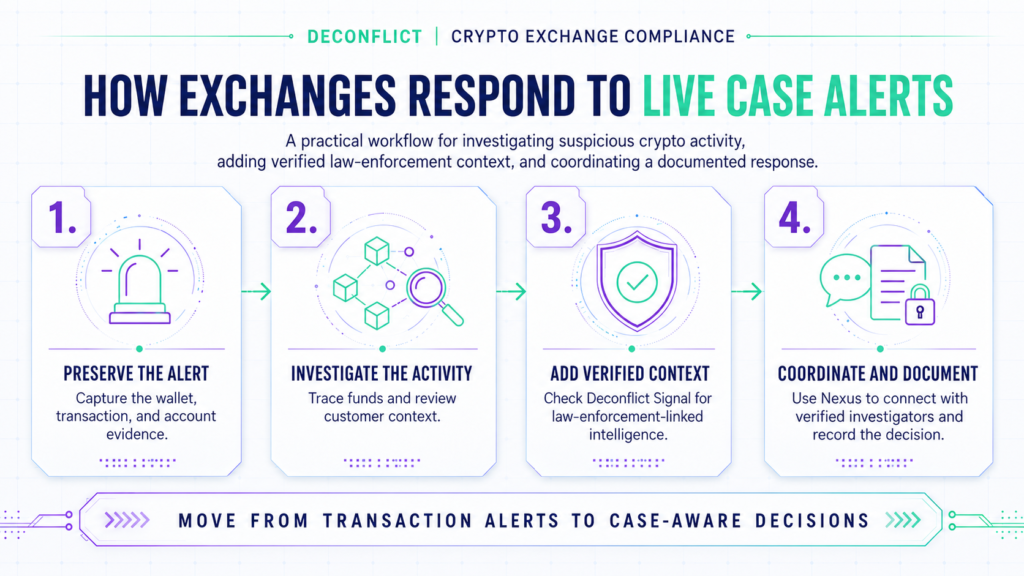
When live case alerts appear, the first priority is to preserve the evidence before it changes.
Capture the wallet address, blockchain, asset, transaction hashes, timestamps, value, counterparties, and exposure paths. Then link that activity to the relevant customer account and collect the internal information needed to understand it, such as KYC data, account history, device information, IP data, linked accounts, and prior case activity where relevant and permitted.
Step 2: Investigate the wallet in its customer context
Once the facts are secure, the analyst can investigate the activity in context.
Review the wallet’s transaction history and the customer’s relationship with the exchange. Trace relevant flows across chains where necessary. Look for connected wallets, repeated counterparties, rapid conversion activity, movement through multiple services, or patterns consistent with scams, laundering, or account takeover.
At the same time, compare what happened on-chain with what the exchange knows off-chain. Does the activity make sense for the customer? Has the customer changed behaviour? Are multiple customer accounts using the same device or funding source? Has the account received funds that appear connected to known scam or fraud patterns?
This is the point where live case alerts become meaningful. They should support a well-developed investigation, rather than replace one.
Blockchain analytics remains essential because it explains the path of funds. Customer and account data remain essential because they explain the exchange relationship. Together, they allow the team to decide whether the alert is isolated, escalating, or potentially connected to a wider case.
Step 3: Add verified law enforcement context with Deconflict Signal
After the exchange has identified the relevant wallet set, it can check Deconflict Signal for verified law enforcement-linked intelligence.
This is a natural next step because the exchange now needs to know whether there is active context that public blockchain data cannot provide.
Signal indicates whether a wallet is flagged or under active investigation by law enforcement. Depending on the available information, that may include active investigative context, a subpoena-related indicator or a deconfliction match. This gives the exchange a basis for understanding that there may be an active matter behind the address.
For live case alerts, that distinction is important. The question is no longer only, “What does this wallet look like?” It becomes, “Is this activity already connected to a verified investigation, and does that change how we should respond?”
Signal fits alongside the exchange’s existing blockchain analytics, transaction monitoring, case-management, sanctions-screening, and SAR workflows. It adds sourced investigative context while keeping the exchange responsible for its own decisions.
Learn more about Deconflict Signal for crypto companies.
Step 4: Coordinate with the verified investigator
When Signal confirms that investigative context is present, the exchange should escalate through its compliance, legal, and law-enforcement response process.
At this stage, timing matters. A poorly considered customer query can compromise a review. An immediate account action may move funds elsewhere. Conversely, a delay may allow funds to leave the platform before the right people can coordinate.
Therefore, the exchange needs a secure way to contact the real person working the matter.
Deconflict Nexus gives financial institutions and law enforcement participants an encrypted channel for operational coordination. Rather than relying on unverified messages or generic inboxes, the exchange can safely communicate with the actual agent or officer connected to the case.
Step 5: Document, monitor, and reassess
The investigation should continue after the first decision.
Record what triggered the alert, what on-chain and customer evidence was reviewed, whether verified law enforcement context was present, who approved the action, and what records were preserved. This creates a clear trail for internal governance, audit, regulatory review, and any later SAR decision.
Moreover, continue monitoring the wallet, linked customer accounts, and related transaction patterns. Live case alerts can develop quickly as funds move across chains, services, and jurisdictions. New activity may strengthen the case, narrow it, or change the appropriate response.
A well-run exchange workflow does not treat an alert as a single event. It treats it as the beginning of a documented, case-aware process.
The takeaway
Live case alerts should move an exchange from isolated alert handling to informed coordination.
Transaction monitoring and blockchain analytics show the activity. Customer data explains the relationship. Cross-agency coordination tools like Signal add verified law enforcement-linked context, while platforms like Nexus help the exchange connect with the real investigator when a case requires coordination.
Since each source answers a different question, the strongest response comes from using them together. The result is a more informed decision, a clearer audit trail, and a better chance of acting at the right moment, in the right direction.
FAQs
1. What should an exchange do when a wallet generates a live case alert?
Start by preserving the transaction, wallet, and customer information tied to the alert. Then investigate the activity across the relevant wallets, counterparties, and account history. Once the wallet set is clear, check Deconflict Signal for verified investigative context. This helps the exchange decide whether it is handling an isolated alert or activity that may require coordinated action.
2. Does an active investigation signal mean the exchange must freeze or close an account?
No. An active investigation signal is important context, not an automatic account action. The exchange should assess the full facts, follow its internal escalation process, and meet its legal and regulatory obligations. A proportionate decision may involve enhanced monitoring, preserving records, escalating internally, or coordinating with law enforcement.
3. How does Deconflict Signal improve transaction monitoring?
Transaction monitoring shows what happened on-chain. Deconflict Signal adds intelligence that helps explain why the activity may matter. It enriches wallet and transaction reviews with verified law enforcement-linked context, typologies, and behavioural indicators. As a result, AML, sanctions, and investigations teams can prioritise the alerts that require deeper review.
4. When should an exchange use Deconflict Nexus?
Use Deconflict Nexus when an investigation needs coordinated action. Nexus gives exchange compliance teams and law enforcement participants a secure operational channel to confirm relevant identifiers, discuss preservation needs and coordinate around time-sensitive activity. It keeps communication connected to the investigation rather than scattered across inboxes, spreadsheets, and disconnected case tools.
5. What is Deconflict, and how do Signal and Nexus work together?
Deconflict is an intelligence and operations platform for financial crime teams working across crypto, AML, sanctions, and investigations. Signal provides investigative intelligence beyond traditional transaction monitoring, helping teams understand connected wallets, entities, typologies, and law enforcement-linked context. Nexus brings alerts, evidence, intelligence findings, workflows, and collaboration into one operational environment. Together, they help exchanges move from an alert to a clearer, better-documented investigation.