The updated CLARITY Act addresses a persistent financial-crime problem: law enforcement agencies and financial institutions often hold different pieces of intelligence about the same illicit network, but they do not always have a fast, secure way to connect them.
Section 10203 would create a federal public-private information-sharing pilot. If enacted in its current form, the program would bring selected government agencies, banks, money services businesses, and digital-asset companies into a structured system focused on potential illicit-finance violations and emerging threats.
That structure matters because digital assets can move across institutions, blockchains, and jurisdictions rapidly. A bank may see customer activity connected to an exchange. The exchange may see a wallet receive suspected fraud proceeds. A local investigator may hold victim reports that explain those transactions, while a federal agency may connect them to a larger network. No participant necessarily sees the whole picture alone.
Short answer: Section 10203 would establish a five-year pilot for secure information sharing among participating government agencies and selected private-sector entities. It would initially include volunteer banks, money services businesses, and digital-asset intermediaries. Participants could communicate through a Treasury portal, secure email, monthly meetings, or a qualifying real-time information-sharing or interdiction network.
What would the proposed pilot do?
Section 10203, titled the “Preventing Illicit Finance Through Partnership Act,” would direct the Treasury Secretary to establish a program through which covered agencies and designated private-sector entities securely share information about potential illicit-finance violations, threats, and emerging risks.
The proposal covers conduct including fraud, money laundering, terrorist financing, sanctions evasion, theft, fentanyl trafficking, elder financial abuse, and transactions involving proceeds of specified unlawful activity.
Its significance extends beyond an endorsement of collaboration. The text addresses who could participate, how information could move, how institutions could use it, and how the pilot could become permanent.
Who would participate?
Covered government participants would include the Department of Justice, including the FBI and Drug Enforcement Administration; the Treasury Department, including FinCEN, the IRS, and the Office of Foreign Assets Control; and the Department of Homeland Security.
The Treasury Secretary, in consultation with the FinCEN director, could also designate federal, state, or local law enforcement agencies and state attorneys general.
The initial private-sector group would consist of 30 consenting participants:
- 10 money services businesses
- 10 digital commodity brokers, dealers, or exchanges
- 10 banks
FinCEN would review the participating entities at least every six months and could replace them when appropriate. Participation would be voluntary.
The proposal could also involve information-sharing and analysis centers, members of certified or recognized information-sharing or interdiction networks, and other private entities relevant to a particular form of illicit activity.
This structure treats regulated institutions as active partners, not merely recipients of government alerts. They would help identify and report activity that may involve illicit finance while operating within defined restrictions.
What information could be shared and used?
A participating agency that opens an investigation or identifies an emerging illicit-finance threat could share information it considers appropriate with a designated private-sector entity.
Unless a regulation or the providing agency allows otherwise, the institution could use that information only to identify and report activity that may involve an illicit-finance violation or related threat.
That limitation is important. An intelligence signal is not automatically proof of criminal conduct or an instruction to freeze, close, or report an account. Institutions would still need to apply independent judgement, legal obligations, internal policies, and documented review procedures.
Responsible sharing also requires verified participants, access controls, data security, traceable communications, and clear escalation processes. Compliance and investigations teams must know where information came from, how it may be used, and what corroboration is needed before action.
How would information move?
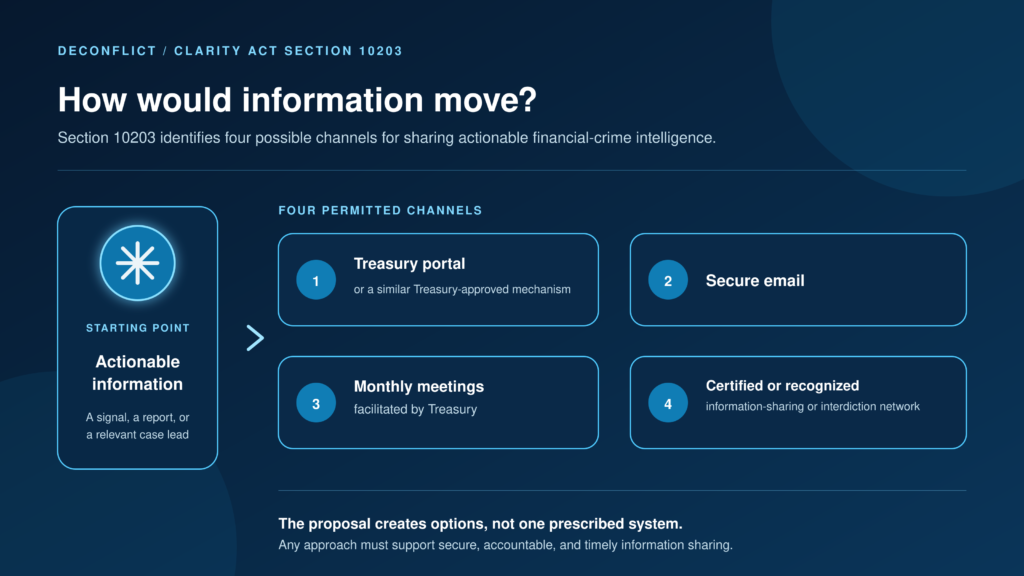
The fourth channel is especially notable. The bill describes such a network as a real-time, secure public-private mechanism supporting rapid information exchange for the detection, interdiction, and prevention of illicit finance.
Treasury could certify a network or recognize a qualifying public-private partnership that existed before enactment if it met equivalent standards for security, accountability, and participation. This leaves room to evaluate existing capabilities instead of requiring every system to be built from scratch. It does not automatically qualify or recognize any current platform.
When would the pilot begin?
If the text were enacted without changing this provision, Treasury and FinCEN would have 90 days to designate the initial 30 private-sector participants.
The pilot would operate for five years after enactment unless the Treasury made it permanent through notice-and-comment rulemaking. The five-year period is the pilot’s duration, not a delay before it begins.
The proposal would also limit certain liability for designated private-sector entities sharing information for the specified purpose. That protection concerns qualifying disclosures and failure to notify a person identified in a disclosure. Institutions would still need legal and compliance review of the final law, implementing rules, and participation requirements.
Why the proposal matters operationally
Transaction monitoring and blockchain analytics remain essential, but they do not always reveal the investigative context behind an address, entity, or transaction. A stronger public-private intelligence loop could help financial institutions prioritize alerts, identify connections to broader criminal networks, improve suspicious-activity reporting, and route urgent matters to verified government counterparts.
Law enforcement faces the same gap from the opposite direction. An agency may know that a wallet relates to a victim complaint but lack visibility into where associated funds are touching the regulated financial system. Another agency may already be investigating the same network, while an institution may be reviewing relevant activity without knowing which investigator holds the missing context.
Secure sharing and deconfliction can help connect those pieces. For state and local agencies, participation could also provide access to a more formal federal and private-sector coordination structure, although the proposal does not guarantee every agency a place.
The underlying network must do more than distribute data. Useful financial-crime intelligence must be credible, timely, secure, specific, and governed well enough to support a defensible decision. Effective deconfliction also requires verified identities and a way to identify overlap without unnecessarily exposing sensitive case material.
Where Deconflict fits
Deconflict supports both sides of this public-private coordination problem. Law enforcement agencies use the network to identify overlapping crypto cases and coordinate investigations. Regulated financial institutions use its institutional capabilities to corroborate alerts against verified law-enforcement-linked intelligence and coordinate through controlled workflows.
Deconflict is not the proposed Section 10203 pilot, and the bill does not name or automatically qualify the platform for federal recognition. The connection is operational: the proposal recognizes a problem that law enforcement and financial institutions already face, while Deconflict provides capabilities designed to help authorized users connect verified intelligence and investigative overlap.
What should financial-crime leaders do now?
The updated CLARITY Act remains proposed legislation and may change. Institutions should not redesign their programs around a draft provision, but they can assess their readiness for more structured public-private sharing.
Leaders should ask whether their teams can:
- Verify a government counterpart’s identity and authority
- Connect an external signal to the relevant customer, account, wallet, and alert
- Record the source, receipt, review, and use of sensitive intelligence
- Coordinate across fraud, AML, sanctions, legal, and investigations teams
- Distinguish an investigative signal from a final determination
- Act within the short window before digital assets move again
The best-prepared organizations will not simply possess more data. They will be able to turn trustworthy intelligence into a controlled, documented, and timely decision.
Conclusion
Section 10203 puts a practical idea at the center of the CLARITY Act’s illicit-finance response: law enforcement and financial institutions need a secure, accountable way to connect intelligence before fragmented information becomes a missed opportunity.
For institutions, that means adding verified context and documented coordination to internal monitoring. For investigators, it means finding relevant institutional and agency counterparts before funds move or cases diverge.
Deconflict is built for that shared operating environment. Financial institutions can request a demonstration of its Verified Intelligence and coordination capabilities. Access for law enforcement is free.
Frequently asked questions
Is Section 10203 currently law?
No. As of July 24, 2026, it appears in updated CLARITY Act text released by Senator Cynthia Lummis. The proposal has not become law and may change.
What would it establish?
A five-year Treasury pilot for secure information sharing about digital-asset illicit finance among participating government agencies and designated private-sector entities.
Which financial institutions would participate initially?
Thirty consenting participants: 10 money services businesses, 10 digital commodity brokers, dealers, or exchanges, and 10 banks.
Could state and local law enforcement participate?
Yes. Treasury, in consultation with FinCEN, could designate federal, state, or local law enforcement agencies and state attorneys general.
Would the pilot support real-time sharing?
Yes. One permitted channel would be a certified or recognized real-time information-sharing or interdiction network.