TL;DR
- A crypto wallet risk score estimates potential exposure and helps teams decide what to review.
- Different analytics providers may assign different scores because they use different data, labels, and methodologies.
- A score does not necessarily show whether activity is tied to a live or known law-enforcement matter.
- Verified intelligence adds confirmed investigative context from participating law-enforcement agencies.
A crypto wallet risk score can help an exchange spot activity worth reviewing. It may reflect exposure to sanctioned entities, high-risk services, scam proceeds, darknet markets, ransomware, or other sources of concern.
That information is valuable. Crypto exchanges need blockchain analytics, transaction monitoring, sanctions screening, and internal controls to review activity at scale.
A score, however, is still an assessment. It may be based on transaction patterns, address attribution, clustering, proximity to a known service, historical exposure, or a provider’s own methodology. It can tell an analyst that a wallet deserves attention. It does not always tell the analyst whether the wallet is connected to a real, current law-enforcement investigation.
That is a different question and it makes a big difference.
Verified Intelligence gives compliance teams additional context about whether a wallet, account, identity, phone number, or other artifact is relevant to a verified investigative matter. It does not replace a crypto wallet risk score. It provides a clearer signal about confirmed investigative relevance.
What does a crypto wallet risk score measure?
A crypto wallet risk score is a provider’s assessment of potential exposure. The score may consider direct or indirect links to known addresses, transaction behavior, entity labels, typologies, sanctions data, or historical activity.
For example, an exchange may receive an alert because a customer wallet received funds from an address associated with a scam operation. The amount of exposure, the strength of the attribution, and the provider’s methodology can all influence the score.
This makes a crypto wallet risk score useful as a starting point. It helps teams locate patterns that would be difficult to review manually across large volumes of transactions.
However, a score does not confirm criminal conduct, or determine the correct account action. It identifies activity that may need further analysis.
Why can the same wallet receive different risk scores?
Compliance teams often use more than one data source. In some cases, the same wallet may receive different scores or labels from different blockchain analytics providers.
That does not automatically mean one provider is wrong.
Providers may differ in how they cluster addresses, classify entities, calculate indirect exposure, weigh historical behavior, or decide when a label is sufficiently supported. One provider may treat an interaction as meaningful exposure. Another may treat the same interaction as too remote to affect the score.
The underlying blockchain is public. The interpretation of that data can vary.
For an exchange, the practical question is not which score should win every time. The more useful question is what the score means, what evidence supports it, and whether there is additional context that changes the significance of the alert.
What a crypto wallet risk score cannot confirm
A crypto wallet risk score can show that activity may warrant review. It cannot always answer the questions that matter most in a time-sensitive case:
- Is this wallet relevant to a verified law-enforcement investigation?
- Has an agency already linked this artifact to victim reports or a known matter?
- Is there a legitimate investigator who needs to coordinate with the exchange?
- Is there a verified source that an analyst can document in the case record?
These are not scoring questions. They are investigative-context questions.
An analytics alert may show a potential connection to risky activity. Verified context can help show whether that connection has surfaced in a real-world investigation.
What does a verified investigative signal mean?
A verified investigative signal indicates that a relevant artifact has a confirmed connection to intelligence contributed through a participating law-enforcement agency.
The result is not a risk score. It is not an estimate or an opaque label generated from a model.
A verified match tells the exchange that there is meaningful investigative context to assess. The exchange can then review the signal alongside its own customer information, transaction history, policies, legal obligations, and escalation procedures.
How can exchanges use both types of intelligence?
Blockchain analytics can help a team understand:
- What exposure or transaction pattern has been observed?
- Which wallets or services may be involved?
- How direct or indirect is the connection?
- Does the activity meet an internal review threshold?
Verified intelligence can help a team understand this, along with:
- Does a relevant artifact match confirmed investigative context?
- Is the activity relevant to a known law-enforcement matter?
- What source information can support the case record?
- How can we collaborate with law enforcement to take the right steps?
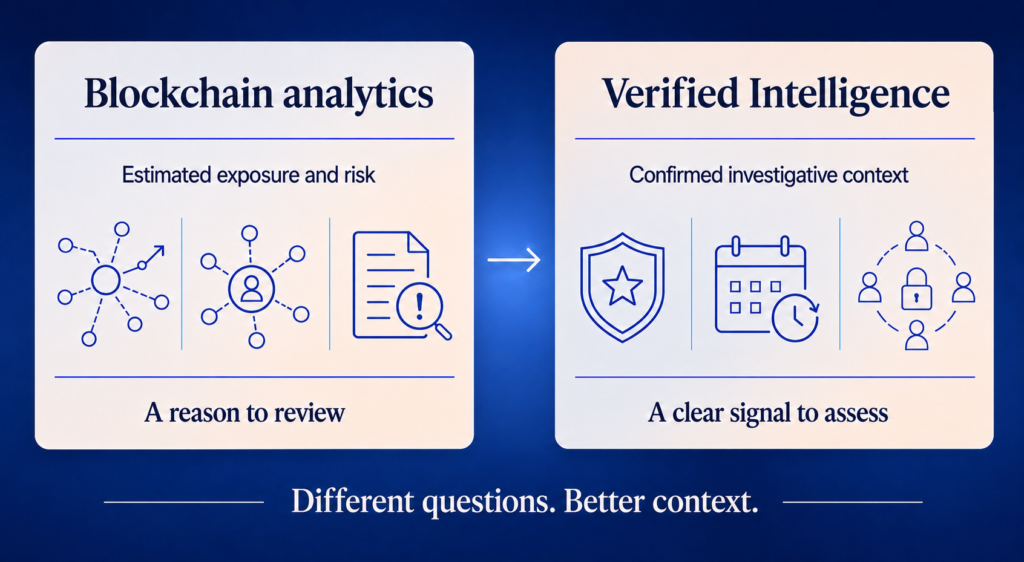
The added value is clarity, speed and precision.
Where Deconflict fits
Deconflict is a verified intelligence platform for financial crime. It sharpens existing blockchain analytics, transaction monitoring, sanctions screening, and case-management with real-world investigative context.
For crypto exchanges, Deconflict adds verified investigative context to the financial-crime workflow. It helps teams determine whether a wallet, account, identity, or related artifact has confirmed relevance to a participating law-enforcement agency’s investigation.
The difference is straightforward.
A crypto wallet risk score helps an exchange assess potential risk. Deconflict helps the exchange assess whether verified investigative context exists.
That context can support a more informed review, stronger documentation, and secure coordination when appropriate.
The takeaway
Blockchain analytics tools are essential for identifying exposure at scale. They help exchanges see patterns, trace transactions, and surface activity that deserves review.
Verified Intelligence serves a different purpose. It helps answer whether a relevant artifact has confirmed significance in a real investigation.
For a compliance team, that is a meaningful distinction. One signal may say, “This activity may be risky.” The other may say, “This activity has confirmed red flags and investigative relevance.”
FAQs
What is a crypto wallet risk score?
A crypto wallet risk score is an assessment of potential exposure to illicit activity, risky services, sanctioned entities, or other sources of concern based on a provider’s data and methodology.
Why do crypto wallet risk scores differ between providers?
Providers may use different attribution methods, clustering models, exposure thresholds, entity labels, and scoring methodologies. Different results do not automatically mean that one provider is inaccurate.
Is a Verified intelligence signal the same as a risk score?
No. A risk score estimates potential risk. Verified intelligence provides confirmed context about whether an artifact has relevance to a verified law-enforcement investigative matter.
Does no verified match mean a wallet is safe?
No. It only means no verified investigative context was returned at that time. Exchanges should continue to apply their normal AML, sanctions, and transaction-monitoring controls.