TL;DR
- Onchain fraud risk indicators should prompt review, not act as automatic proof of wrongdoing.
- The strongest signals combine transaction behavior, wallet relationships, timing, and intelligence from reliable sources.
- Bridges, privacy tools, and rapid transfers can be legitimate, so context matters.
- A defensible decision record separates observed facts from inference and explains the action taken.
- Verified investigative context can clarify whether an alert has relevance beyond a probabilistic score.
A blockchain alert is not proof of fraud. For crypto exchanges, banks, and fintech compliance teams, the harder question is whether activity reflects a meaningful threat, legitimate but unusual behavior, or something that needs more review. Onchain fraud risk indicators help teams answer that question when they are observable, corroborated, and tied to a clear reason for concern.
One transaction, protocol interaction, or wallet label rarely explains intent. Strong reviews consider behavior, wallet relationships, customer activity, and intelligence provenance.
What are onchain fraud risk indicators?
Onchain fraud risk indicators are observable blockchain behaviors, wallet relationships, or transaction patterns that may warrant review because they are associated with known fraud activity. They can include repeated exposure to reported scam infrastructure, coordinated movement through several wallets, quick dispersal of funds, or activity consistent with a recognized fraud typology.
The word “may” matters. A signal can justify investigation without establishing that a customer or wallet committed fraud. It prevents teams from escalating harmless activity or dismissing a meaningful pattern.
Why isolated alerts create false positives
A single data point is rarely enough. High volume may be market-making or treasury activity. A bridge interaction can be normal DeFi use. Even a privacy-enhancing tool needs an assessment of source of funds, destination, history, and customer profile.
Context changes the question. A bridge used by a long-standing customer with consistent behavior presents a different review than a newly funded wallet that receives likely scam proceeds, splits them across fresh addresses, and routes them to the same off-ramp as related accounts.
What makes a signal reliable?
The most useful onchain fraud risk indicators meet three practical tests: they are observable, repeatable, and contextual.
The concern should be grounded in facts an investigator can review, such as transaction flows, timestamps, token movements, and wallet relationships. “High-risk wallet” is not a complete rationale. “The wallet received funds from multiple addresses connected to victim reports and moved them through the same route within hours” explains what was observed.
Reliable onchain fraud risk indicators also appear across documented cases or recognizable typologies. Consistency across several observation windows generally deserves more weight than one unusual transaction.
Context determines significance. A wallet relationship becomes more concerning when customer information, transaction history, known typologies, or credible intelligence support it.
Which behaviors should teams examine?
Behavior over time can expose preparation and coordination. The following onchain fraud risk indicators are useful when several appear together.
Structured funding and route testing
Fraud operations may start with small transactions. Operators can fund a fresh wallet, test a bridge or exchange deposit address, then repeat the route at a larger scale. One test is ordinary. A recurring sequence across related wallets, followed by fast consolidation or dispersal, merits review.
Sudden changes in activity
Dormancy followed by a sharp rise in transaction frequency, new counterparties, or unfamiliar protocols can justify review, especially when it conflicts with expected customer behavior.
How do wallet relationships add context?
Fraud is rarely limited to one address. A wallet that looks low risk alone may warrant attention when it receives funds from wallets linked to unrelated scam reports, sends funds to a common intermediary, or moves assets alongside other wallets in a narrow window.
Network-based onchain fraud risk indicators can include:
- Repeated exposure to wallets named in credible fraud reports
- Common deposit, consolidation, or dispersal addresses
- Synchronized activity among otherwise separate wallets
- Use of the same swap route, bridge, or off-ramp
- Intermediary wallets collecting from many unrelated senders
These links are not proof. They help teams decide whether an alert is isolated or part of a broader operational pattern, which informs whether to monitor, contact the customer, restrict activity, or escalate.
How should compliance teams validate onchain fraud risk indicators?
A repeatable process reduces alert fatigue without requiring teams to wait for certainty. Record the behavior that prompted the review, then test whether it persists, connects to relevant counterparties, fits a known typology, and conflicts with expected customer activity.
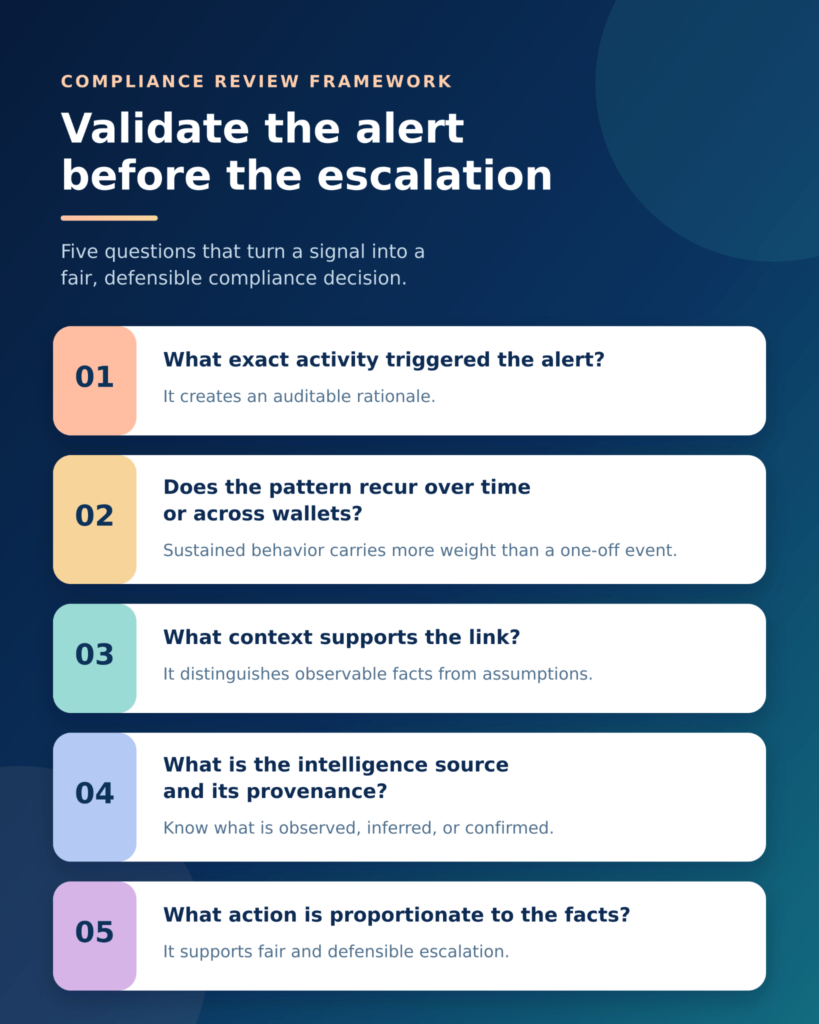
This framework turns onchain fraud risk indicators into a documented decision.
Where verified investigative context fits
Blockchain analytics and transaction monitoring surface patterns, assign risk, and support initial triage. Yet some decisions call for a different question: has this activity appeared in a relevant investigative matter?
Deconflict adds a distinct source of context. Intelligence contributed through participating law enforcement agencies can provide relevant investigative signals with provenance and an audit trail. This helps organizations assess whether onchain fraud risk indicators have confirmed context beyond a pattern-based assessment.
It does not replace due diligence, internal investigation, or existing analytics tools. It gives teams another way to understand an alert before deciding what to do next.
The takeaway for financial-crime teams
The best onchain fraud risk indicators do not promise certainty. They give analysts a structured reason to gather context and make proportionate decisions. Review behavior, relationships, timing, and provenance together.
For teams with crypto exposure, know what triggered concern, what corroborates it, and what justifies the response.
FAQs
What are the most reliable onchain fraud risk indicators?
The most reliable onchain fraud risk indicators are supported by multiple facts, including repeated exposure to reported fraud infrastructure, coordinated wallet activity, and structured fund movement over time.
Can one blockchain alert prove a wallet is fraudulent?
No. A single alert can justify review, but it rarely proves fraud. Teams should assess transaction history, counterparties, customer information, and other credible intelligence before reaching a conclusion.
Are bridges and privacy tools always signs of fraud?
No. These tools have legitimate uses too. Their relevance depends on how they were used, when they were used, and whether other onchain fraud risk indicators support concern.
How can an exchange reduce false positives in wallet screening?
An exchange can document the behavior behind an alert, compare it with the customer profile, review wallet relationships, and distinguish observed facts from inferred risk before escalating.
What is the difference between a risk score and verified investigative context?
A risk score estimates risk using a provider’s data and methodology. Verified investigative context provides attributable information that may explain whether activity relates to a relevant investigative matter.