TL;DR
- The proposed CLARITY Act treats public-private information sharing as a practical part of digital-asset enforcement, not a side issue.
- Section 10203 would create a five-year Treasury pilot for secure information sharing among government agencies, banks, money services businesses, and digital-asset firms.
- Sections 10204, 10903, 10904, and 10905 extend the same idea through policy input, training, cyber response, stolen-fund recovery, and scam prevention.
- The operational challenge is not simply detecting suspicious activity. It is moving verified context to the right people quickly enough to support a lawful next step.
Section 10203 would establish an operational information-sharing pilot. Section 10204 would create a public-private working group. Section 10903 would train government personnel to use investigative and information-sharing tools and coordinate across agencies. Section 10904 would establish a federal center for cyber-threat response and stolen-fund recovery in collaboration with industry. Section 10905 would create a cross-sector task force focused on cryptocurrency scams.
Short answer: The updated CLARITY Act treats information sharing as essential to combating digital-asset crime because law enforcement, financial institutions, and technology companies often hold different parts of the same threat picture. Several provisions would create distinct channels for operational exchange, policy development, training, cyber response, scam prevention, and interdiction.
The proposal recognizes a practical limitation of financial-crime investigations. Blockchain data may be visible, but investigative context is still fragmented.
Section 10203 would create an operational information-sharing pilot
Section 10203, the Preventing Illicit Finance Through Partnership Act, is the clearest operational expression of the bill’s information-sharing strategy.
If enacted in its current form, it would direct the Treasury to establish a five-year pilot through which participating government agencies and designated private-sector entities could securely share information concerning potential illicit-finance violations, threats, and emerging risks.
The initial private-sector group would include 10 banks, 10 money services businesses, and 10 digital commodity brokers, dealers, or exchanges. Federal agencies would participate, and Treasury could designate state and local law-enforcement agencies and state attorneys general.
The section also identifies several possible channels for exchange, including a Treasury portal, secure email, monthly meetings, and a certified or recognized real-time information-sharing or interdiction network.
This is more than a general call for cooperation. The proposal addresses:
- Who could participate
- What information could be shared
- How participants could communicate
- How private-sector recipients could use the information
- What security and accountability standards would apply
- When the pilot would end or could become permanent
For a detailed explanation, see the related article.
Section 10203 matters to law enforcement and financial institutions because it attempts to create a structured intelligence loop. Agencies can contribute investigative context. Institutions can identify and report relevant activity within their systems. The value comes from connecting those perspectives, not treating either side as a passive recipient.
Section 10204 would turn cross-sector expertise into policy recommendations
Section 10204 addresses a different layer of the problem.
It would establish the Independent Financial Technology Working Group to Combat Terrorism, Narcotics Trafficking, and Illicit Financing. Its membership would combine federal departments and agencies with representatives from digital-asset companies, distributed-ledger analytics companies, financial institutions, research organizations, privacy and civil-liberties organizations, state financial regulators, and state or local law enforcement.
Unlike Section 10203, this is not primarily an operational channel for sharing case intelligence. It is a policy body.
Its role would include examining how terrorists, narcotics traffickers, transnational criminal organizations, and other illicit actors use emerging technologies. It would also develop recommendations concerning laws, regulations, and private-sector tools for countering those threats.
The distinction is important:
- Section 10203 asks how authorized participants can exchange relevant intelligence.
- Section 10204 asks how public and private expertise can improve the rules and tools used against illicit finance.
Policy recommendations are stronger when they reflect operational reality. Investigators understand where cases stall. Financial institutions understand where legal, technical, and compliance constraints affect action. Technology providers understand what data and analytical capabilities can show. Privacy representatives can identify where a proposed solution creates unnecessary or disproportionate exposure.
Bringing those perspectives together does not guarantee consensus. It can, however, reduce the risk of creating policy that looks workable on paper but fails in the field.
Section 10903 would make coordination part of federal training
Information-sharing infrastructure is only useful if personnel know how and when to use it.
Section 10903 would require the Treasury and the Department of Justice to establish a digital-asset law-enforcement and national-security training program within 180 days of enactment.
The program would serve a broad government audience, including federal, state, local, Tribal, and territorial investigators, prosecutors, analysts, regulators, and other personnel with digital-asset or illicit-finance responsibilities.
Its proposed curriculum would cover more than blockchain tracing. The text expressly includes:
- Illicit finance, sanctions, AML, fraud, cybersecurity, customer protection, and national-security provisions
- The respective roles of Treasury, DOJ, the SEC, and the CFTC
- Investigative, supervisory, reporting, referral, information-sharing, and customer-protection tools
- Coordination among law-enforcement agencies and federal financial regulators
That scope reflects an important lesson. Technical skill alone does not solve a coordination failure.
An investigator may be able to trace funds but still need to determine which agency has jurisdiction, which institution should receive a lawful request, whether another investigator is working the same addresses, and how to share enough information to move the case forward without exposing sensitive material unnecessarily.
Training therefore becomes part of the information-sharing architecture. It creates a common understanding of tools, roles, authorities, referral paths, and escalation procedures.
Section 10904 would connect information speed to disruption and recovery
Section 10904 would establish the Digital Asset Cyber Innovation Center within the Treasury, operated with multiple federal agencies and in collaboration with private-sector entities.
The center’s focus would differ from the broad illicit-finance pilot. It would concentrate on state actors that target or use digital assets for illicit purposes, digital-asset cybersecurity, cyber-threat response, and the identification, tracing, seizure, and recovery of stolen funds.
The proposal would require continuous exchange with appropriate private-sector entities, including exchanges, blockchain analytics firms, cybersecurity companies, Web3 development platforms, and other relevant parties. It also directs the center to promote frequent, real-time public-private information sharing for efficient responses to emerging cyber threats.
One of the most revealing details appears in the reporting requirements. The center’s annual report would include:
- Threat actors disrupted
- Dollars recovered
- Progress in public-private cooperation
- Information-sharing effectiveness, including the speed of sharing
Speed is not treated as an abstract performance metric. It is connected to operational outcomes.
Digital assets can move through several addresses and services in minutes. A correct intelligence signal that arrives after the assets have left a reachable intermediary may still help an investigation, but its opportunity to support immediate interdiction or recovery has diminished.
Section 10904 therefore connects three stages that are often discussed separately:
- Detect the threat.
- Move trustworthy intelligence to the right parties.
- Coordinate action before the opportunity closes.
That sequence is central to understanding why deconfliction matters. Knowing that two organizations have relevant information is useful. Enabling them to identify the overlap, verify the relationship, and coordinate securely is what turns the match into operational value.
Section 10905 would apply a cross-sector model to cryptocurrency scams
Section 10905, the SAFE Crypto Act, would establish a Task Force for Recognizing and Averting Cryptocurrency Scams within 180 days of enactment.
Its proposed membership would span federal agencies, permitted payment stablecoin issuers, digital-asset service providers, custodians, distributed-ledger analytics companies, victims and scam-support organizations, federal, state, and local law enforcement, and state bank regulators.
The task force would examine financial-grooming scams involving digital assets, identify effective prevention methods, and recommend improvements. The bill directs it to take a cross-sector approach because scams affect victims across jurisdictions and industries, including financial services, telecommunications, and technology.
The proposal also encourages the task force to promote participation by digital-asset service providers and stablecoin issuers in public-private, real-time information-sharing and interdiction networks.
This provision illustrates why a scam cannot always be understood as one victim, one transaction, or one jurisdiction.
The same criminal network may:
- Contact victims through different platforms
- Direct payments through multiple banks, exchanges, kiosks, and wallets
- Reuse infrastructure across several states
- Move proceeds through common consolidation addresses
- Trigger separate reports to institutions and agencies that do not know the reports are connected
When those signals remain isolated, each organization sees a smaller incident. When trustworthy intelligence is connected, investigators and institutions may see the broader network.
Section 10905 is therefore not simply a consumer-education provision. Its structure recognizes that preventing and disrupting cryptocurrency scams requires information from victims, law enforcement, financial services, technology companies, and analytical providers.
Where Deconflict fits
Deconflict is built around the fragmentation problem these provisions recognize.
For law enforcement, crypto case deconfliction can help identify when separate agencies are working matters connected by the same wallet or other relevant indicator. That allows verified investigators to recognize overlap and coordinate without assuming that blockchain visibility alone provides the whole investigative picture.
For financial institutions, Deconflict’s institutional capabilities add verified law-enforcement-linked context to existing financial-crime workflows and support controlled coordination. This is complementary to transaction monitoring, blockchain analytics, KYT, AML, fraud, sanctions, and case-management systems. Those systems help institutions detect and assess risk. Deconflict adds a layer of verified investigative context.
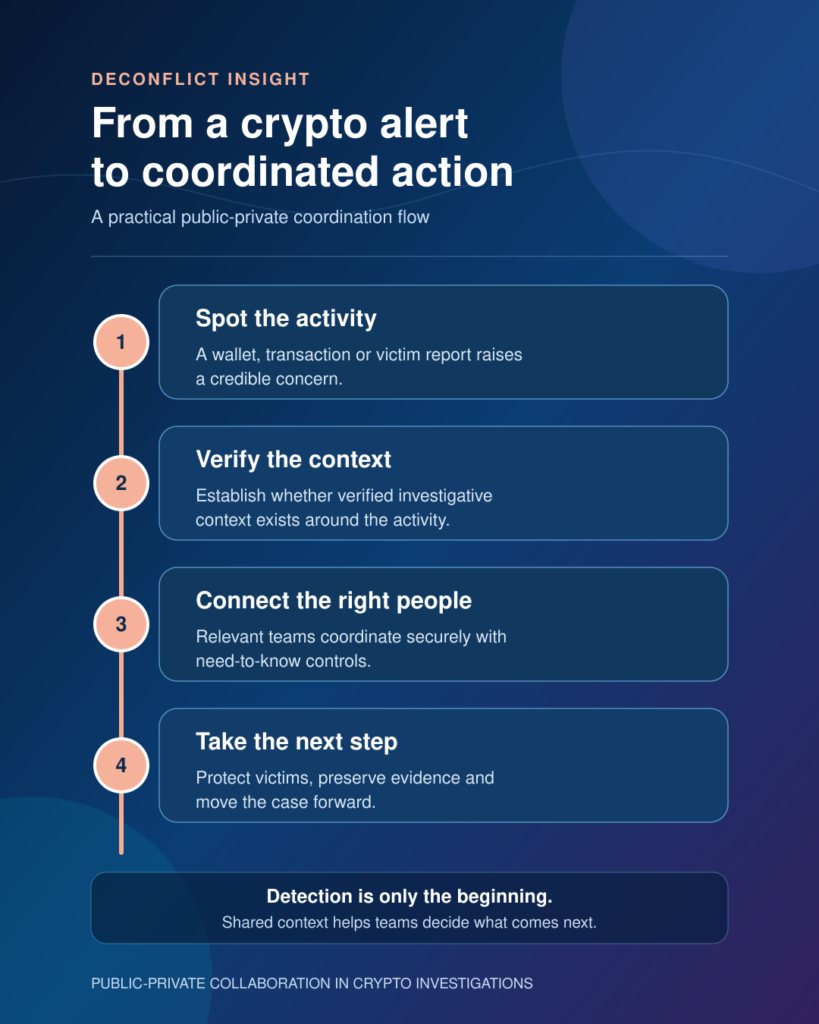
The natural connection is more practical:
The CLARITY Act reflects federal recognition of a coordination problem that law enforcement and financial institutions already face. Deconflict gives those organizations an immediately available way to improve case deconfliction, Verified Intelligence, and secure coordination while the legislative process continues.
Frequently asked questions
- What does the CLARITY Act propose for information sharing?
The bill proposes several channels with different purposes. Section 10203 would establish a Treasury-led pilot for operational sharing among authorized public- and private-sector participants. Other provisions address policy recommendations, training, cyber response and cryptocurrency scam prevention.
- Is Section 10203 the same as FinCEN Section 314(b)?
No. Section 314(b) is an existing voluntary information-sharing framework among eligible financial institutions. Section 10203 would be a proposed five-year pilot involving government agencies and designated private-sector participants, including digital-asset businesses.
- Would the CLARITY Act require agencies to share entire case files?
No. The draft describes structured channels for sharing relevant information and includes security and accountability requirements. The appropriate scope of sharing would still depend on legal authority, the investigation, and the participant’s role.
- Why does speed matter in crypto investigations?
Digital assets can move across wallets and services quickly. Timely, trustworthy information can help the right organization assess whether a lawful preservation, reporting, interdiction, recovery, or investigative step is appropriate before the opportunity narrows.
- Does the bill select Deconflict or another specific platform?
No. The draft legislation does not name, select, certify, or endorse Deconflict or any other existing platform. Deconflict’s relevance is that it addresses the same real-world challenge: helping verified participants identify overlap and coordinate securely without treating blockchain data as the complete investigative picture.