TL;DR
- AML and fraud teams have plenty of alerts, yet often lack the context to understand which ones connect to real harm.
- Verified investigative intelligence links an alert to trusted sources such as active investigations, victim reports, subpoenas or verified law-enforcement activity.
- This helps teams prioritise urgent cases, rather than treating every unusual transaction with the same level of concern.
- It strengthens fraud prevention by revealing when different scam types may be using the same wallets, cash-out routes or criminal infrastructure.
Today, financial crime teams have more data than ever. They can see transactions in real time, screen names against watchlists, trace activity across wallets and flag suspicious activity instantly.
However, more visibility has not made every decision easier. Fraud and laundering networks have learned to work across the gaps between institutions. A victim may be persuaded to send funds through a bank, convert them to crypto through an exchange and then move them through a cluster of wallets before they reach a cash-out point. Each organisation sees part of the event. Very few see the whole operation.
That is an emerging challenge facing AML and fraud teams. They are not short of alerts. They are short of the context needed to understand which alerts connect to real harm, active investigations and wider criminal infrastructure.
This is where verified investigative intelligence changes the equation. It gives teams more than a reason to look at an alert. Teams get a clearer understanding of why it may matter, what may already be known and whether there is a real investigator or live case behind the signal.
Why are traditional alerts no longer enough?
Transaction monitoring and fraud detection systems are built to identify anomalies. A customer may suddenly send large amounts to new beneficiaries. An account may receive funds from several unrelated parties. A crypto wallet may interact with a high-risk address or move assets through multiple services in a short period.
These are important signals. They do not, however, explain intent.
The same unusual transaction can mean very different things. It may be a customer making an unfamiliar but legitimate payment, it may be a victim being manipulated by a scammer, it may be a mule account moving stolen funds or may be one small piece of a much larger laundering operation.
Therefore, the core challenge is not simply detecting risk. It is understanding the significance of that risk quickly enough to make the right decision.
Most monitoring tools are strongest when they look at what is happening inside one organisation. But modern fraud groups operate differently. They use different accounts, platforms, jurisdictions and assets to make every individual transaction appear less obvious.
A bank may see an incoming payment, while an exchange sees the crypto conversion and law enforcement sees several victim complaints connected to the same destination wallet. Viewed separately, these events may look ordinary enough. Viewed together, they may reveal a live, thriving fraud network.
What is verified investigative intelligence?
Verified investigative intelligence is information that has a known and trusted investigative basis. It may be connected to an active law-enforcement investigation, documented victim reports, a subpoena or a verified agency submission.
The difference is provenance.
A generic label may tell an analyst that an address is risky. A risk score may indicate the level of risk. Open-source reporting may suggest that an entity has been associated with fraud. All of these inputs can be useful.
Verified intelligence adds another layer. It tells the team that the signal is connected to real investigative activity and gives them a clearer basis for assessing what to do next.
How does this change alert prioritisation?
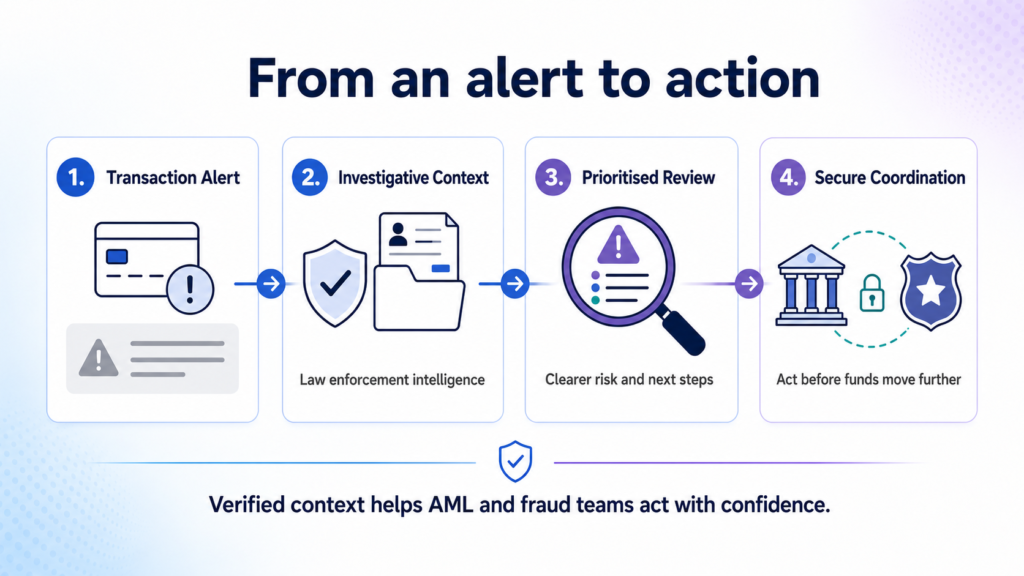
The most immediate impact of verified investigative intelligence is that it helps teams separate unusual alerts from potentially urgent alerts.
A standard alert may deserve review because the activity falls outside a customer’s normal pattern. On the other hand, an alert linked to a verified active investigation may deserve faster escalation because the underlying funds could be connected to current victim harm, a live cash-out route or evidence that needs to be preserved.
Without investigative context, all alerts can sit in the same queue. Analysts then have to rely on transaction patterns alone to decide which case should move first.
With investigative context, teams can prioritise based on more than volume, value or risk score. They can focus on cases where intervention may prevent further loss, protect victims or help an investigation move forward.
Why does it matter for fraud teams?
Fraud teams are often measured by the speed at which they prevent losses and protect customers. That makes context especially valuable.
A victim of an investment scam may be persuaded to send multiple payments over several weeks. After losing money, the same victim may be approached by a fake recovery service that claims it can retrieve their funds for a fee. A romance scam victim may eventually be directed to an investment platform or a crypto wallet.
These incidents can appear unrelated when they arrive as separate reports. In reality, the same network may be using overlapping wallets, accounts, phone numbers, domains, cash-out services and social-engineering methods.
Verified investigative intelligence helps fraud teams recognise those connections sooner.
Teams can assess whether a payment is part of a known illicit trail or destination. That can shape how they take the next steps, escalate cases internally and identify additional accounts or transfers that need attention.
How does it strengthen AML investigations?
AML teams need to make decisions that are proportionate, well documented and defensible. They need to understand not only what happened, but why the activity creates financial-crime risk.
Verified investigative intelligence gives analysts a better starting point for that work.
When a signal is attributable to a trusted investigative source, it can help an analyst decide whether to continue monitoring, seek additional information, restrict activity, preserve records or file a suspicious activity report. It can also improve the quality of the case narrative.
A useful SAR does not simply list transactions. It explains the activity, the parties involved, the timeline and the reason the conduct may be suspicious. Investigative context helps teams do that with more specificity and less assumption.
This is also important for audit and regulatory review. A decision supported by attributable information and a clear record of why the alert was escalated is easier to explain than one based on a black-box score alone.
Why does secure coordination matter?
An intelligence match is valuable. Still, it is only the beginning.
Once a team identifies activity connected to a live case, it may need to know the next steps, whether specific records should be preserved or whether there is a relevant point of contact. Searching for the right agency through public channels can take time that a fast-moving fraud case does not have.
This is why verified investigative intelligence is most effective when it is paired with secure coordination.
Deconflict’s Signal provides attributable intelligence that helps teams understand whether an alert may be connected to law enforcement investigative activity. Nexus then gives verified law-enforcement agencies and regulated financial institutions a secure, auditable channel to coordinate when follow-up is needed.
The goal is to let each side contribute what it knows, through a controlled process, when their information overlaps.Through a safe and secure public-private partnership ecosystem, disruption of illicit flows will be faster and more effective.
What should financial crime teams do next?
AML and fraud teams should not view investigative intelligence as a replacement for monitoring, analytics or internal expertise. It works best as a layer that adds meaning to existing systems.
The practical question is whether a team can answer three things when an alert appears: Is there verified context behind this signal? Can we explain why it matters? Can we securely coordinate if the case requires it?
Financial crime networks already share infrastructure across institutions and borders. The teams trying to stop them need a way to connect the dots too.
Verified investigative intelligence makes that possible. It helps organisations move from reviewing isolated alerts to understanding connected harm, then acting with greater speed, confidence and purpose.
FAQs
What is verified investigative intelligence?
It is attributable intelligence tied to a trusted investigative source, including active cases, verified law-enforcement information, victim reports or legal process.
Does verified intelligence prove a customer committed a crime?
No. It provides context for a risk decision. Each organisation must still apply its own legal, compliance and investigation processes.
Can it help reduce false positives?
Yes. It helps teams distinguish between activity that is merely unusual and activity that may be connected to an active or documented investigative concern.
Why is it important in crypto fraud?
Crypto assets can move quickly across wallets and services. Investigative context helps teams identify urgency before funds are further layered or cashed out.
How does Deconflict help?
Deconflict helps financial institutions and digital-asset businesses access verified investigative context and coordinate securely with verified law-enforcement partners.